Showing posts with label orthopedic specialist. Show all posts

Wednesday, 8 February 2017

Get Relief from Ankle Pain

Ankle pain points out to any type of pain or discomfort in the ankles. This pain could be caused due to an injury, like a sprain or by a medical condition such as arthritis. An ankle sprain is one of the most common causes of ankle pain. Once healed, the sprained ankle is sometimes permanently weaker and less stable than the other ankle.

What causes ankle pain?
A sprain is the most common cause of ankle pain. Also, ankle pain can be caused due to:
  • Arthritis, specifically osteoarthritis
  • Gout
  • Nerve damage or injury, such as sciatica
  • Blocked blood vessels
  • Infection in the joint

When to see a doctor about ankle pain?
A doctor must be consulted when you can't put weight on the ankle and the joint looks disfigured. This means that the ankle is broken. If the ankle makes a popping sound when it is moved, you should consult a doctor.

http://drraju.in/treatments-offered/arthroscopy/ankle-arthroscopy/

Long term solution for ankle pain:
A sprained ankle will mostly heal on its own. However, a sprained ankle is weakened and more prone to be sprained again. A severe sprain will require surgery. Osteoarthritis is considered as chronic and painful condition. Nothing can be done to completely eliminate the ankle pain associated with arthritis or keep it from returning.

How to prevent ankle pain?
Pain caused by medical conditions, such as arthritis, cannot be prevented. Still, the following can be done to avoid sprains and other lifestyle-related injuries to the ankles:
  • Wear the type of shoes that fit well and provide ample ankle support.
  • Avoid wearing high-heeled shoes
  • Stretch the ankles and legs before exercising or any heavy physical activity.
  • Always wear ankle support gear while doing activities that strain the ankles.
  • Lose weight and be fit to reduce the stress on the ankles

Dr. Raju Easwaran, is the famous orthopaedic surgeon in New Delhi. He is very trusted in arthroscopy, joint replacement surgery and all orthopaedic related problem.

http://drraju.in/contactus/

Visit Us: http://drraju.in
Email Us: drrajueswaran@gmail.com

Tuesday, 2 June 2015

Shoulder Arthroscopy Treatment and Recovery

SHOULDER ARTHROSCOPY

What is shoulder arthroscopy

Shoulder arthroscopy like knee arthroscopy is an operative procedure wherein the interior shoulder joint is inspected with a 4 mm camera and using one or two similar sized cuts, a variety of surgical procedure can be done.


Why shoulder arthroscopy?

With advances in orthopaedic technology, modern shoulder arthroscopy allows as a patient to get a full, fast and almost painless recovery after surgical procedure. Surgeries that previously required 6 inches long incision, prolonged hospitalization and blood loss can now be managed with small 4mm cuts, day care admission and minimum blood loss. That translates in to a smooth recovery and minimum interference with your daily routine.

Do you require a shoulder arthroscopy?

Yes you do, if you have any one of the following conditions.
  • Multiple shoulder dislocations
  • Major tears of important shoulder muscles (rotator cuff tears) causing pain, especilaly in the night.
  • Extra bone growth in the shoulder pressing on rotator cuff and causing pain & weakness (impingement syndrome)
  • Frozen shoulder which has not responded to steroid injections and physiotherapy.

Are there any risks or complications that I must be aware of?

Shoulder arthroscopy is a very safe procedure, but like most surgical procedures, it has its own set of known complications:
  • Swelling over the shoulder accommpanies nearly every surgery. This is because we need to pump in saline in to the joint under high pressure to see it properly and some of the saline gets collected around the joint. This will resolve over a week's time.
  • Stiffness of the shoulder will be experienced by most patients initial 2-3 months after the surgery, especially if a pair has been done. Gradual physiotherapy will help you regain strength in 3-6 months after the surgery.
  • Apart from these, the risks of anaesthesia, infection, bleeding, etc. Are best discussed face-to-face with your treating surgeon.

How long does it take to recover fully?

For the first 6 weeks after the surgery, your shoulder will be kept immobilized in a sling. Gentle exercises called pendulum exercises are allowed in this time period. After 6 weeks the sling is taken off, and gradual movements and strengthening are begun. Its generally takes you till 3 months after the surgery to get back to normally (the above does not apply for frozen shoulder release, where full recovery is expected in 1-2 weeks time).

RECURRENT SHOULDER DISLOCATIONS

Why surgery?

Shoulder arthroscopy in India is most commonly done for multiple shoulder dislocations. The shoulder is the most mobile joint of the human body and this mobility comes at the cost of poor stability. There is a tissue in the shoulder called the glenoid labrum, which acts like a speed breaker and prevents shoulder dislocations. Once the shoulder dislocates in any directions due to trauma (ususlly the front) this speed breaker is torn. That is the reason that once dislocated, the shoulder keeps on redislocating to the tune of 90%, if the first dislocation is sustained below 30 years of age. The patient lives in a continuous fear of his/her shoulder dislocating all the time.

What is done in surgery?

When we operate shoulder dislocations, we aim to reattach the torn portion of the labrum back to the bone (glenoid). This can be done with tiny 4mm punctures, using specialized screws called anchors (generally 2-3), which go deep inside the bone and allow us to stitch the torn tissue properly.

ROTATOR CUFF TEARS

Why surgery?

The rotator cuff is the deep muscle of the shoulder. It is responsible for the smooth movements of the shoulder joints. Patients in whom it is torn are suddenly unable to lift their shoulders, or are only able to do so with considerable pain. The arm becomes weak, and in longstanding cases stiffness and arthritis sets in. There is continuous pain especially in the night, while lying down on the affected side. It generally happens in patients who are more than 40 years old, though young people can also sustain it following an injury due to roadside accidents or sports.

What is done in surgery?


Surgery for rotator cuff tears involves removing a little bit of bone from the undersurface of the shoulder, to create room for the muscle to move smoothly. Anchors are used (generally 2-4) to reattach the torn muscle back to where it belongs.

Saturday, 23 May 2015

Health Tips for Computer Users

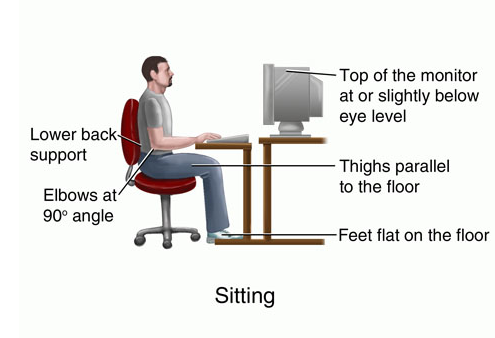
It is very important to keep a good posture while your working with a computer. Understand about the concept of neutral body positioning will help you to set up your computer work station in a best way. This concept will help you to maintain a good and comfortable working posture, this makes your joints in to natural and proper alignment. Neutral positioning will reduce the stress and strain on your muscles, tendons and skeletal system, also reduces the risk of developing a musculoskeletal disorder (MSD). In some situations you might need the help of an orthopedic specialist. Here we have listed some important key points when trying to maintain neutral body postures while working with computer.


  • Keep your hands, wrists and forearms straight, inline and roughly parallel to the floor.
  • Your head position should be above screen level or bent slightly forward, forward facing, and balanced. Generally it is in-line with the torso.
  • Shoulders should be relaxed and hang upper arms normally at the sides of body.
  • Keep elbows close to the body and bent between 90 and 120 degrees.
  • Give a complete support to the feet by the floor or foot rest.
  • Use chairs with a good back support with appropriate lumbar support when sitting vertical or leaning back slightly.
  • Thighs and hips are supported by a well-padded seat and generally parallel to the floor.
  • Knees are about the same height as the hips with the feet slightly forward.


working in the same posture or sitting still for a long interval of time may cause health disorders, so change your working posture frequently throughout the day in the following ways.

  • Make some adjustments to your chair or backrest.
  • Stretch your arms, hands, fingers and torso.
  • Stand up and walk around for a few minutes periodically


To know about joint pain and other orthopedic treatments consult our orthopedic doctor in New Delhi
website : www.drraju.in